
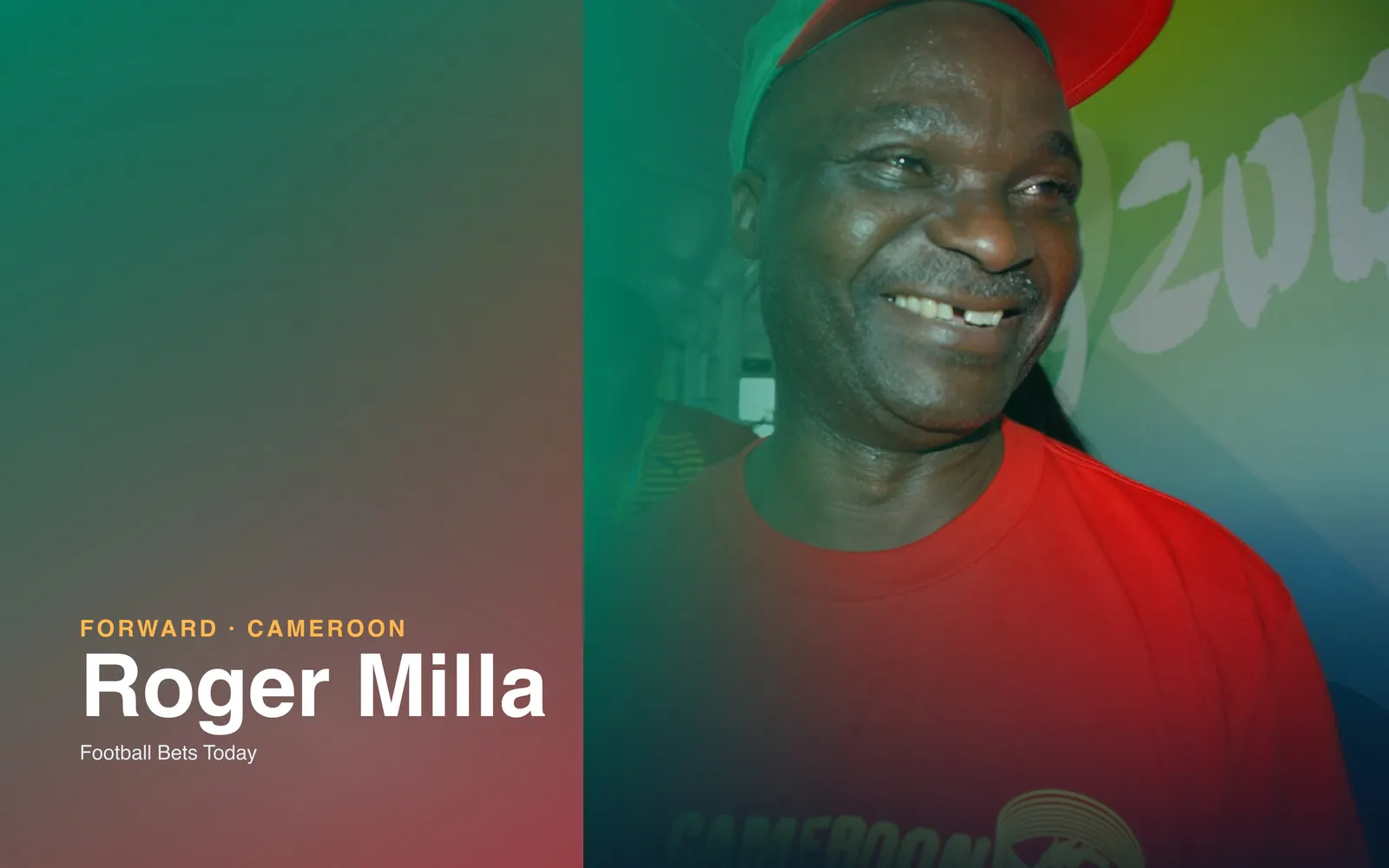
Forward · Cameroon · born 1952
Career by season, honours, the Indomitable Lions record and the reported net worth, with the current club and this season's numbers in the modules.
Career
Clubs by season
| Club | From | To | Apps | Goals | Note |
|---|---|---|---|---|---|
| Éclair de Douala | 1967 | 1970 | 57 | 6 | permanent |
| Léopard Douala | 1970 | 1974 | 116 | 89 | permanent |
| Tonnerre Yaoundé | 1974 | 1977 | 87 | 69 | permanent |
| Valenciennes | 1977 | 1979 | 28 | 6 | permanent |
| Monaco | 1979 | 1980 | 17 | 2 | permanent |
| Bastia | 1980 | 1984 | 113 | 35 | permanent |
| Saint-Étienne | 1984 | 1986 | 59 | 31 | permanent |
| Montpellier | 1986 | 1989 | 95 | 37 | permanent |
| Saint-Pierroise | 1989 | 1990 | 23 | 8 | permanent |
| Tonnerre Yaoundé | 1990 | 1994 | 116 | 89 | permanent |
| Pelita Jaya | 1994 | 1995 | 23 | 23 | permanent |
| Putra Samarinda | 1995 | 1996 | 12 | 18 | permanent |
Appearances and goals are to the end of the last completed season; this season's numbers load from the feed.
Indomitable Lions
Debut 1973 · 77 caps · 43 goals (to 1994)
Honours
- Cameroon Première Division 1971-72, 1972-73, 1973-74 · Léopard Douala
- African Cup Winners' Cup 1975 · Tonnerre Yaoundé
- Coupe de France 1979-80 · Monaco
- Coupe de France 1980-81 · Bastia
- Africa Cup of Nations 1984, 1988 · Cameroon
- Afro-Asian Cup of Nations 1985 · Cameroon
- African Footballer of the Year 1976, 1990
- AFCON Best Player 1986, 1988
- AFCON top scorer 1986, 1988
- FIFA World Cup Bronze Boot 1990
- FIFA World Cup All-Star Team 1990
- CAF Best African Player of the last 50 years 2007
- FIFA 100 (2004)
- Golden Foot Legends Award 2014
- Knight of the Legion of Honour 2006
Reported net worth
just over USD 1 million (Sports Brief, 2023)
Published estimates, not accounts. The figure carries its publisher and year.
In depth
About Roger Milla
Key takeaways
- Roger Milla, born Albert Roger Miller on 20 May 1952, is a retired Cameroon striker.
- He finished his playing career with Putra Samarinda in Indonesia in 1996.
- Milla scored four goals as a substitute at the 1990 World Cup as Cameroon reached the quarter finals.
- He became the oldest World Cup finals scorer against Russia in 1994, aged 42 years and 39 days.
- His commonly listed Cameroon record is 77 caps and 43 goals, although international appearance counts differ.
Roger Milla is a retired Cameroon football striker, born Albert Roger Miller on 20 May 1952 in Yaoundé. He played for Pelita Jaya and Putra Samarinda in Indonesia between 1994 and 1996, scoring 41 league goals across the two clubs before retiring. Across African football, also known as soccer, the lasting image is his corner flag dance at the 1990 World Cup. His story also deserves the dates behind the celebration, from his career in Cameroon to his final international appearances.
Milla became Cameroon's best known World Cup figure because his finishing changed what an African team could achieve on that stage. The joy of his celebration drew attention, but the football underneath explains its importance. His Africa Cup of Nations titles in 1984 and 1988 give supporters across the continent another route into his story. His career brings together those continental memories, a long club journey and questions about his finances that require careful attribution.
Who Is Roger Milla?
Albert Roger Miller, known in football as Roger Milla, was a striker whose international career stretched from 1973 to 1994. His performances for Cameroon at the 1990 and 1994 World Cups gave his story a reach well beyond his club following. His birth date provides the lasting answer to searches about Roger Milla age today: calculate from 20 May 1952, allowing for whether his birthday has passed.
Albert Roger Miller is his birth name; Roger Milla is the name associated with his playing career. For readers exploring African footballers, his international performances provide a starting point for understanding Cameroon's World Cup history.
A useful way to understand his career is to separate three strands: his development in Cameroonian club football, his years playing abroad and his international tournament performances. That approach gives the African clubs their place in the story and helps explain why a biography built only around the 1990 World Cup would leave so much unexplored.
How Did Milla Travel From Douala to Indonesia?
Milla's club journey included Éclair de Douala, Léopard Douala and Tonnerre Yaoundé before his move abroad. Tonnerre's African Cup Winners' Cup victory in 1975 belongs near the centre of that early story. His African Footballer of the Year award in 1976 also shows that continental recognition preceded the World Cup celebration that later made him familiar worldwide.
Valenciennes brought him to France in 1977, followed by Monaco in 1979 and Bastia in 1980. He won the Coupe de France with Monaco in the 1979 to 1980 season and Bastia in the 1980 to 1981 season. The moves continued to Saint Étienne in 1984 and Montpellier in 1986. These spells matter when assessing the Roger Milla footballer beyond international highlights: he built a substantial French club career before his defining World Cup summer.
He left Montpellier for Saint Pierroise in Réunion in 1989 and later returned to Tonnerre Yaoundé. The Réunion chapter makes the route to the 1990 World Cup especially striking. His next great international contribution did not follow a fresh move to a prominent European club. It came after a different kind of football chapter in the Indian Ocean. That sequence helps explain why his career remains such a useful example when supporters discuss experience and the value of an older forward.
Indonesia supplied the final club chapters: Milla played for Pelita Jaya and Putra Samarinda between 1994 and 1996, scoring 41 league goals across both clubs. His playing career ended in 1996. The timeline below includes his return to Cameroon and groups the Indonesian clubs within their shared date range. Transfer fees for these moves are not documented in the sources used.
| Club | Years |
|---|---|
| Éclair de Douala | Before his move to France in 1977 |
| Léopard Douala | Before his move to France in 1977 |
| Tonnerre Yaoundé | Before his move to France in 1977 |
| Valenciennes | 1977 to 1979 |
| Monaco | 1979 to 1980 |
| Bastia | 1980 to 1984 |
| Saint Étienne | 1984 to 1986 |
| Montpellier | 1986 to 1989 |
| Saint Pierroise, Réunion | 1989 to 1990 |
| Tonnerre Yaoundé | Return after his Réunion spell |
| Pelita Jaya and Putra Samarinda | 1994 to 1996 combined; 41 league goals across both clubs |
What Did Roger Milla Do on the Pitch?
Milla's defining World Cup performances showed how a striker could read a defender's hesitation and turn it into a scoring chance. His four goals in 1990 all came as a substitute, making the timing of his involvement part of the achievement. Against Romania, his two goals showed how a replacement forward could reshape a match. For anyone studying his movement, the useful question is where he positioned himself before the chance, rather than how long he had already been playing.
The Colombia match in 1990 provides the clearest single performance to revisit. Milla scored twice in extra time as Cameroon advanced to the quarter finals. His contribution gives viewers a reason to follow the attacking moves as closely as the celebrations. The corner flag dance became part of the memory of Cameroon's 1990 tournament.
His goal against Russia in 1994 added a different kind of distinction. At 42 years and 39 days, he became the oldest scorer in World Cup finals history, although Cameroon exited in the group stage. The lesson for a young forward watching those performances is practical: follow the whole attacking sequence, including the moments before the ball arrives. Studying the decisions before his finishes reveals more of his craft than watching the celebration alone.
For a closer viewing exercise, pause before Cameroon regain possession and identify Milla's position relative to the ball, his nearest defender and the available passing route. Then watch how those relationships change. This turns an archive match into a study of attacking decisions, with attention on the choices a forward can make as well as the finish.
What Is Roger Milla's Cameroon Record?
Milla made his Cameroon debut in 1973, and Wikipedia records 77 caps and 43 goals through his international career ending in 1994. Other published totals include 81 and 105 appearances. The difference concerns which fixtures enter the count, particularly unofficial friendlies and matches outside a strictly defined senior international record. Readers should compare totals only when the counting rules match. The 77 appearance figure is the reference used here, rather than a claim that every historical list uses identical boundaries.
He won the Africa Cup of Nations in 1984 and 1988, with a runners up finish in 1986 between those titles. Milla also received the tournament's best player and leading scorer honours in 1986 and 1988. Those achievements make his standing broader than a World Cup reputation, even if the 1990 images remain the easiest to recall.
His individual honours include African Footballer of the Year in 1976 and 1990, the World Cup Bronze Boot in 1990 and selection for Pelé's FIFA 100 in 2004. His last Cameroon appearance was a friendly against South Africa in December 1994, a direct connection for Bafana Bafana supporters. Keep that international endpoint separate from his retirement from club football in 1996. They answer different questions, and combining them can make an otherwise accurate career summary confusing.
Roger Milla net worth
Sports Brief estimated Roger Milla's net worth at just over USD 1 million in 2023, attributing the money to his football career and other businesses without giving a calculation. Such figures are published estimates, not accounts. The attribution is available through a search summary; the full article could not be checked.
For salary, the available summary of Sports Brief's 2023 report provides no figure; it also provides no separate image rights income, market value or named endorsements. None of those omissions establishes a zero value, and there are no reported amounts in these categories to convert.
For a rough illustration, USD 1 million converts to ₦1.5 billion, KSh130 million, USh3.7 billion, R18 million or GH₵12 million using assumed rates of 1,500 naira, 130 Kenyan shillings, 3,700 Ugandan shillings, 18 rand and 12 cedis per dollar. The reported estimate of just over USD 1 million would sit slightly above those amounts. These are illustrative conversions using rounded assumptions, not historical exchange rate quotations for 2023 or live valuations.
Net worth means assets less liabilities, while a wage describes income over a period. Sports Brief's 2023 estimate gives no calculation of assets or liabilities, so it does not establish Milla's career earnings or how much wealth he retained. Currency conversions add no evidence about his finances.
How Can Fans Watch Milla From Nigeria, Kenya, South Africa, Ghana and Uganda?
Milla is retired, so watching him means finding historical match coverage, archive programmes and documentaries rather than a forthcoming club fixture. Nigerian supporters can begin with Cameroon's 1984 continental campaign and the 1990 World Cup matches. For Ghanaian readers comparing African World Cup heroes, the Colombia match provides a particularly useful benchmark. Watch the full sequence around his goals when available, because short celebration clips leave out the positioning and pressure that created the chance.
Kenyan and Ugandan readers searching for the Milla corner flag dance can use the Romania and Colombia matches as their starting points. His Cameroon performances offer a shared point of interest for football audiences across Africa. South African viewers have an additional historical route through the December 1994 Cameroon friendly against Bafana Bafana. Archive availability varies, so consult the viewing information supplied for your country before choosing a programme.
For an archive broadcast, confirm the programme date before converting its start time. An illustrative 19:00 GMT listing means 19:00 in Ghana, with Nigeria reading 20:00 WAT; South Africa reads 21:00 SAST, while Kenya and Uganda read 22:00 EAT. This example does not announce a broadcast featuring Milla. Check whether a scheduled programme begins with studio coverage or goes straight to the match replay.
When choosing an archive recording, check the tournament year, opponent and whether the programme contains the full match or selected highlights. For the Colombia match in 1990, a recording that includes extra time is especially useful. If watching with younger supporters, follow Cameroon's attacking build up together before replaying the goals, so the celebration stays connected to the football that produced it.
FAQ
What is Roger Milla's net worth?
Sports Brief estimated Roger Milla's net worth at just over USD 1 million in 2023. This is a published estimate, not accounts: the available search summary attributes his wealth to football and other businesses but gives no calculation, and the full article could not be checked.
Which club does Roger Milla play for?
Roger Milla retired from club football in 1996, finishing with Putra Samarinda. Between 1994 and 1996, he played for Putra Samarinda and Pelita Jaya in Indonesia, scoring 41 league goals across both clubs. His earlier career included spells in France with Montpellier and Saint Étienne.
How many caps does Roger Milla have?
Wikipedia lists 77 appearances and 43 goals for Cameroon across his international career from 1973 to 1994. Counts of 81 and 105 appearances also appear in historical records, reflecting differences in which fixtures are included. Check the counting definition before comparing totals.
When was Roger Milla born?
Milla was born in Yaoundé on 20 May 1952, with the birth name Albert Roger Miller. Calculate his age from that date, taking account of whether 20 May has passed in the year concerned.
How old was Roger Milla when he scored at the 1994 World Cup?
Milla was 42 years and 39 days old when he scored against Russia at the 1994 World Cup, setting the record for the oldest scorer at the finals.
Written by Tunde Akinwande, 2026-11-11.