
Munich, Germany · opened 2005
Capacity 75,024. Who plays here, the matches it is known for, and how to get there.
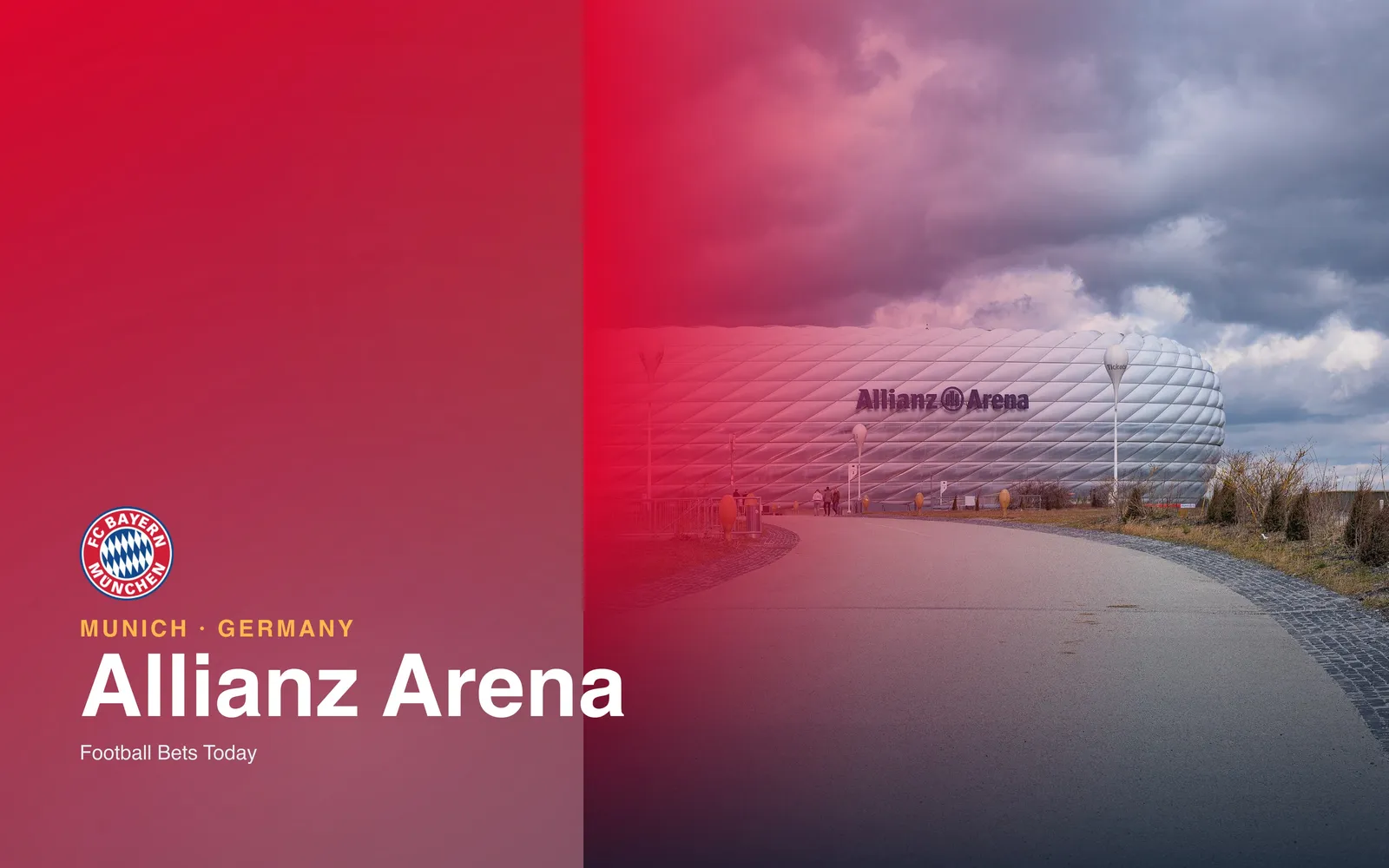
The ground
Facts
| Capacity | 75,024 |
|---|---|
| Opened | 2005 · renovated Capacity raised in 2012–13 and 2014; seats redone in red and white, 2018 |
| Official name | Allianz Arena, named for Allianz SE since it opened in 2005 |
| Surface | hybrid |
| Owner | Bayern Munich (bought 1860 Munich's 50% share in 2006) |
| Record attendance | 70,132 · Carolina Panthers v New York Giants (NFL) (2024) |
| Getting there | Fröttmaning station on the U6 U-Bahn line. There are four car parks with about 9,800 spaces, close to the A9 motorway. |
History
Matches it is known for
- 2006 World Cup opening match, Germany 4–2 Costa Rica
- 2012 Champions League final, Chelsea beat Bayern on penalties
- Euro 2020 matches
- Euro 2024 opening match and a semi-final
- 2025 Champions League final, PSG 5–0 Inter
- First NFL regular-season game in Germany, 2022
In depth
About Allianz Arena
Key takeaways
- Didier Drogba scored and converted the decisive penalty at the Allianz Arena in Chelsea's 2012 Champions League triumph.
- Its capacity was about 75,000 for domestic football and about 70,000 for international and European matches in the 2024 configuration.
- Sadio Mané played for Bayern from 2022 to 2023, while Eric Maxim Choupo-Moting represented the club from 2020 to 2024.
- A 20:30 German kick-off in winter converts to 20:30 WAT, 22:30 EAT, 21:30 SAST and 19:30 GMT.
The Allianz Arena is Bayern Munich's football stadium in Munich, Germany, with a capacity of about 75,000 for domestic matches in its 2024 configuration. International and European matches use a configuration of about 70,000, the distinction football and soccer supporters need when comparing capacity figures.
For a supporter planning from Lagos or Accra, the illuminated exterior is the easy part to recognise; the useful details are the station, ticket category and kick-off clock. The ground also carries African memories, especially Didier Drogba's decisive contribution to Chelsea's European triumph there in 2012. That final gives the arena a place in African football history beyond its striking exterior.
What Is the Allianz Arena Stadium Capacity?
The Allianz Arena stadium capacity was approximately 75,024 for domestic football in 2024, usually rounded to 75,000. The corresponding international and European configuration held about 70,000. Different seating and standing arrangements explain why two sensible answers appear beside the same ground. For a Bundesliga visit, use the domestic figure as your reference; for a European fixture or international tournament, read the event's seating information before choosing a section. Capacity describes the arrangement available, rather than the attendance at every match.
Who Plays at the Allianz Arena?
Bayern Munich are the resident club, while 1860 Munich shared the arena from its opening in 2005 until 2017. Bayern ended 1860 Munich's rental contract in July 2017 and became the sole tenant. That distinction matters when older photographs show blue illumination or accounts describe the ground as a joint home. A fixture listing should identify the competition and designated home team, particularly when a tournament takes over the stadium.
Germany also play internationals here, and major finals bring clubs whose usual homes are elsewhere. The arena hosted the Champions League finals in 2012 and 2025, alongside international tournament matches. For visitors comparing football stadiums, this is an important distinction: Bayern supply the regular rhythm, while tournament organisers determine the arrangements for their events. Read the venue field as well as the team names before making travel plans.
How Do You Get to the Allianz Arena?
Fröttmaning on Munich's U6 underground line is the station for the Allianz Arena, with a pedestrian approach completing the journey. Allow for that walk when choosing your train, particularly for a match with a large crowd. A visitor arriving from Lagos or Accra should leave a separate interval between landing in Munich and beginning the stadium journey.
Driving is another option, with about 9,800 spaces across four stadium car parks listed in 2024. Read the parking information attached to your event before choosing that route. For a group travelling together from Africa, agree on a meeting point near Fröttmaning before entering the arena so that the return journey does not depend on everyone leaving their seats together.
Why Does the Allianz Arena Glow Red, Blue or White?
The arena's illuminated skin uses approximately 2,760 ETFE foil panels, a defining feature of its 2005 design. The original colour scheme associated red with Bayern, blue with 1860 Munich and white with Germany or neutral events. Think of the colours as a visual introduction to the occasion, with the shared tenancy explaining the blue in older images. Special illuminations can serve other purposes, so the exterior colour alone should never replace the fixture details when identifying an event.
When Was the Allianz Arena Built?
The Allianz Arena opened on 30 May 2005, following the groundbreaking on 21 October 2002 and construction between 2003 and 2005. Herzog & de Meuron designed the stadium, with Arup responsible for structural engineering. The overall cost was about €340 million including financing, with construction accounting for about €286 million. Opening day brought a 3 to 2 friendly victory for 1860 Munich over Nürnberg, giving the ground a shared beginning before Bayern became its sole resident club.
Samuel Kuffour's Bayern story belongs to the period before the arena opened: the Ghanaian defender belonged to the club from 1993 to 2005 and won the Champions League in 2001. His Bayern home was the Olympiastadion; his legacy should not be presented as an Allianz Arena playing career.
Which Major Football Matches Have Been Played Here?
The arena hosted the 2006 World Cup opener and the Champions League finals in 2012 and 2025. For many African supporters, the defining match remains the 2012 final. Drogba scored Chelsea's equaliser and converted the decisive penalty against Bayern, putting an Ivory Coast international at the centre of the stadium's European history. That is a stronger connection than simply counting African names in a squad list.
Euro 2024 brought Germany's 5 to 1 opening victory over Scotland and Spain's 2 to 1 semi-final win over France. The arena also hosted Nations League Finals matches in 2025. Bayern's African connections include Senegal's Sadio Mané, who played for the club from 2022 to 2023, and Cameroon's Eric Maxim Choupo-Moting, whose Bayern career ran from 2020 to 2024. Nigerian readers can place those careers within a wider German football connection: Super Eagles midfielder Jay-Jay Okocha played for Eintracht Frankfurt from 1992 to 1996, before the Allianz Arena opened.
Why Is It Called Munich Football Arena?
Munich Football Arena and Fußball Arena München are competition names for the Allianz Arena, used in UEFA competitions, while Allianz holds the naming rights under a 30 year agreement. The 2006 World Cup used FIFA WM-Stadion München, commonly rendered in English as FIFA World Cup Stadium Munich. These labels identify the same ground in Fröttmaning, rather than successive stadiums or a move across Munich.
How Do Tickets, Tours and the Museum Work?
Match tickets, stadium tours and museum visits are separate arrangements, so check exactly what an admission includes before booking. A tour can explain the building and take visitors into areas available on that particular route, while the museum follows Bayern's history. Match preparations can change access, and a tour reservation does not imply permission to watch a fixture. For an international tournament or final, read the event's own admission instructions because the usual club match arrangements may differ.
For a Ghanaian visitor interested in Kuffour's 2001 European title, or a Senegalese supporter tracing Mané's 2022 to 2023 Bayern career, check which historical displays the museum visit includes. Choose your match section separately and read its entrance instructions before travelling to Fröttmaning. Allow time to reach your seat after entering the stadium, with admission details ready to show. A visit centred on the building can focus on its illuminated exterior; a visit centred on African players benefits from checking the museum programme first.
How Can Fans Across Africa Follow Bayern Matches?
An Allianz Arena fixture needs a local clock reading before supporters across Africa arrange their viewing. The relevant zones are WAT for Nigeria, EAT for Kenya and Uganda, SAST for South Africa and GMT for Ghana. Munich observes CET during winter and CEST during summer; that seasonal change alters the conversion for the same German start time. The table illustrates a 20:30 start without assigning that hour to any particular match.
For a shared viewing evening in Nairobi or Kampala, put the EAT start time in the group invitation and confirm coverage of the named competition before choosing a venue. A South African household can use the SAST column when arranging television access, while friends joining from Lagos or Accra need the WAT or GMT reading. Consult the fixture's country viewing information because Bundesliga and Champions League coverage can differ. Use the squad module for African players' involvement, then check the fixture date before making the final viewing arrangement.
| German Clock | Nigeria: WAT | Kenya and Uganda: EAT | South Africa: SAST | Ghana: GMT |
|---|---|---|---|---|
| 20:30 CET, winter | 20:30 | 22:30 | 21:30 | 19:30 |
| 20:30 CEST, summer | 19:30 | 21:30 | 20:30 | 18:30 |
FAQ
What is the capacity of Allianz Arena?
The 2024 configuration held approximately 75,024 for domestic football, usually rounded to 75,000. International and European matches used a configuration of about 70,000.
Who plays at Allianz Arena?
Bayern Munich are the resident club, and Germany also play internationals there. The arena was shared with 1860 Munich from 2005 until 2017 and also hosts major tournament matches.
How do I get to Allianz Arena?
Use Munich's U6 underground line and leave the train at Fröttmaning. The remaining approach to the Allianz Arena is on foot, so include walking time in your arrival plan.
Why is Allianz Arena called Munich Football Arena?
Munich Football Arena is its name in UEFA competitions. Allianz holds the stadium's naming rights under a 30 year agreement.
When did the Allianz Arena open?
The stadium opened on 30 May 2005. Its opening match was a friendly in which 1860 Munich beat Nürnberg 3 to 2.
Written by Tunde Akinwande, 2026-11-11.