
West Bridgford, Nottingham, England · opened 1898
Capacity 30,404. Who plays here, the matches it is known for, and how to get there.
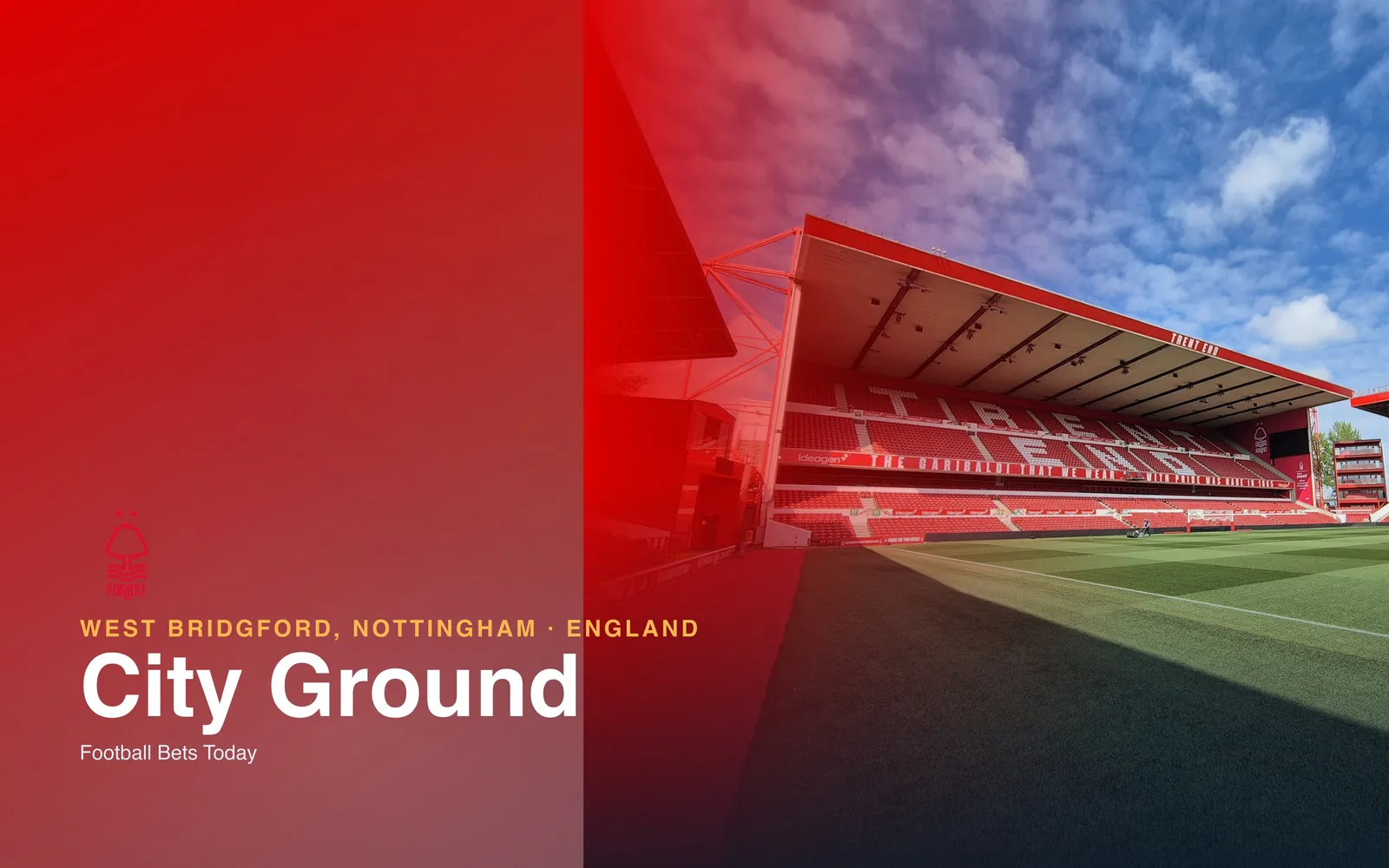
The ground
Facts
| Capacity | 30,404 |
|---|---|
| Opened | 1898 · renovated Riverside Stand rebuilt in the 2020s |
| Official name | The City Ground |
| Surface | grass |
| Owner | Nottingham Forest FC |
| Record attendance | 49,945 · Nottingham Forest v Manchester United, First Division (1967) |
| Getting there | Nottingham station is about 1 mile away, with the Trent Bridge crossing close to the ground. The A52 and A606 serve it. |
History
Matches it is known for
- Euro 96 group matches
- Home ground during Nottingham Forest's back-to-back European Cup wins (1979 and 1980)
- 1967 record crowd v Manchester United
In depth
About City Ground
Key takeaways
- The City Ground is Nottingham Forest’s riverside home in West Bridgford, Nottingham.
- The visitor capacity figure used here is approximately 30,445, dated November 2026, rather than a promise of available tickets.
- The Premier League capacity includes 7,500 for away fans.
- Forest’s European Cup victories in 1979 and 1980 explain the importance of the Brian Clough and Peter Taylor stand names.
- Expansion approval reported in September 2026 does not mean the proposed additional seats are already available.
The City Ground is Nottingham Forest’s home beside the River Trent in West Bridgford, Nottingham. For a visit planned against the November 2026 reference figures, use approximately 30,445 seats. It is a ground for football (soccer to many South African readers) with more than a century of history.
For an African supporter, the attraction reaches beyond the stadium photograph. Forest’s European Cups connect the record book to a compact riverside ground, and Nigeria internationals Ola Aina and Taiwo Awoniyi both joined the club in 2022. Understanding the stands, the river and your ticket entrance makes the journey easier, especially when Nottingham follows a long flight from home.
What Is the City Ground Capacity?
The City Ground capacity figure used in this guide is approximately 30,445, dated November 2026. Other references give 30,576 or 31,212, so the number needs a date and a definition. Published totals can reflect different seating configurations, operational restrictions or reporting dates; they should not be treated as interchangeable ticket inventories. For planning, the smaller working figure is useful, while your ticket remains the authority for an individual seat.
Away allocations need particular care because they depend on the competition and arrangements for the fixture. The Premier League capacity of 30,445 includes 7,500 for away fans. The historical crowd record is 49,946, for Forest against Manchester United on 28 October 1967. That record does not describe the number admitted under modern seating arrangements.
Who Plays at the City Ground?
Nottingham Forest men have played at the City Ground since 1898, and Forest Women began playing there in 2024. Check the relevant team fixture listing before travelling, because a club name alone does not identify which side your ticket covers. Among England’s football stadiums, this one combines a long established men’s home with a newer chapter for the women’s team.
The Nigerian connection includes Ola Aina and Taiwo Awoniyi, who both joined Forest in 2022. Their player profiles should carry dated career and squad information, rather than a permanent stadium guide promising either will appear. For the women’s schedule, consult the Nottingham Forest Women team guide and confirm the venue attached to the match.
How Do I Get to City Ground From an African Airport?
Travel first to Nottingham, then continue to the City Ground on foot, by bus or by taxi. Begin by comparing flight connections from Lagos, Nairobi, Johannesburg, Accra or Kampala with the onward journey to Nottingham, rather than choosing on airfare alone. If arriving through a London airport, allow for the airport transfer before the Nottingham train. Check a dated journey planner for actual train times, changes and the final service after the match.
The River Trent lies between the city centre and the ground, so choose your crossing before setting off, then follow signs and steward directions to your stand. Nearby bridges do not all deliver you to the same entrance, and a riverside shortcut can become a longer walk. Confirm any bus direction and service before boarding.
What Should Drivers and Away Supporters Know?
Drivers should arrange parking before travelling, while away supporters should follow the entrance printed on their ticket. Reaching Nottingham is different from finding a suitable place to leave a car near the stadium. Check council parking information and match arrangements, allow for congestion around the river crossings, and leave time to walk from your chosen space. Do not assume neighbouring streets provide unrestricted parking.
Once the journey is arranged, keep the ticket, address and stadium map available offline. On arrival, identify your turnstile before joining a queue, particularly if you support the visiting side. A little preparation here works like agreeing the meeting point before leaving a busy Lagos bus stop: everyone knows where the journey ends.
Why Do Clough, Taylor and the European Cups Matter?
The City Ground matters because it was Forest’s home during the European Cup victories of 1979 and 1980 under Brian Clough. The 1979 final is the defining match for many neutral visitors, when Forest became European champions. The trophy was won away from Nottingham, but the achievement gives the home ground its wider significance. It also explains why the Brian Clough Stand and Peter Taylor Stand names deserve attention alongside the silverware.
The ground opened on 3 September 1898 against Blackburn Rovers, with about 15,000 spectators. Its riverside setting brought a different kind of landmark in March 1947, when the Trent flooded the stadium. The main stand suffered a major fire on 24 August 1968, before later rebuilding reshaped the ground. These dates explain why the City Ground is a collection of different building periods, and why the attractive river setting also requires serious flood planning.
Which City Ground Stand Should I Choose?
The ground has four named stands: the Peter Taylor Stand, the Brian Clough Stand, the Trent End and the Bridgford Stand. Your block and row matter as much as the stand name, especially when judging height, proximity and any stated viewing restriction. Use the stadium map linked with ticket information to locate your precise seat and see how the stand sits in relation to the pitch.
The Executive Stand opened in August 1980 and later took Brian Clough’s name, while the main stand became the Peter Taylor Stand in October 2015. The Bridgford Stand was rebuilt in 1992 and 1993, followed by the Trent End between 1994 and 1996. The ground then hosted three Euro 96 group matches in June 1996. Its later hosting of the Women’s FA Cup finals in 2007 and 2008 adds another reason to look beyond the men’s league programme.
| Stand | Dated fact | Visitor Guide |
|---|---|---|
| Peter Taylor Stand | The main stand, named in October 2015 | Check the block, row and any stated viewing restriction. |
| Brian Clough Stand | Opened as the Executive Stand in August 1980, later renamed | Use the stadium map to judge your view from this stand. |
| Trent End | Rebuilt between 1994 and 1996 | Check how your row affects the view of the pitch. |
| Bridgford Stand | Rebuilt in 1992 and 1993 | Away supporters should follow their allocated block and entrance. |
How Close Is Meadow Lane, and What Has Expansion Approval Changed?
Meadow Lane, home of Notts County, is approximately 270 metres from the City Ground across the Trent, making them the closest professional grounds in England. That distance describes their proximity, rather than a direct walking route between entrances. The river makes the relationship distinctive: two football homes share a small stretch of Nottingham’s landscape, but visitors still need a bridge. Check your destination carefully if combining photographs of both grounds with a match visit.
Expansion approval was reported on 17 September 2026, following Rushcliffe Borough Council’s approval of the first phase on 16 September 2026. The full scheme envisages about 52,500 seats. These are development figures, rather than operating capacity. Use the existing seating plan until ticket information confirms that a new section has opened.
How Should Visitors Plan Tickets and Follow Matches From Africa?
Plan the visit around a valid ticket and the fixtures module, which carries match dates and kick off details. Ticket access can depend on membership, sales windows and the competition, so establish eligibility before committing to travel. Arrive early enough to find the correct stand, complete entry checks and settle before kick off. Consult the stadium map supplied with ticket guidance, since entrances and usable routes can change during building work.
For readers in Nigeria, Kenya, South Africa, Ghana and Uganda, each fixture shows WAT, EAT, SAST and GMT together, so compare all four. WAT applies in Lagos, EAT in Nairobi and Kampala, SAST in Johannesburg and GMT in Accra. Britain’s seasonal clock change alters the gap between them. Use the viewing module for dated broadcast availability before arranging an evening at home, a bar or a viewing centre. Confirm the displayed local time again before setting off, whether your journey ends beside the Trent or beside a television.
FAQ
What is the capacity of City Ground?
Use approximately 30,445 as the November 2026 visitor reference capacity. Published figures differ, and proposed expansion totals describe future development rather than available seats.
Who plays at City Ground?
Nottingham Forest men have played there since 1898, and Nottingham Forest Women began playing there in 2024. Check the team and venue shown against the fixture before buying travel.
How do I get to City Ground?
Travel to Nottingham, then continue on foot, by bus or by taxi, choosing your River Trent crossing in advance. Check a dated journey planner and follow the entrance on your ticket.
When did City Ground open?
The City Ground opened on 3 September 1898 against Blackburn Rovers, with about 15,000 spectators.
How many away fans can City Ground hold?
The Premier League capacity of 30,445 includes 7,500 for away fans. Your ticket confirms the block and entrance for an individual match.
Written by Tunde Akinwande, 2026-11-11.