
London, England · opened 1924
Capacity 25,194. Who plays here, the matches it is known for, and how to get there.
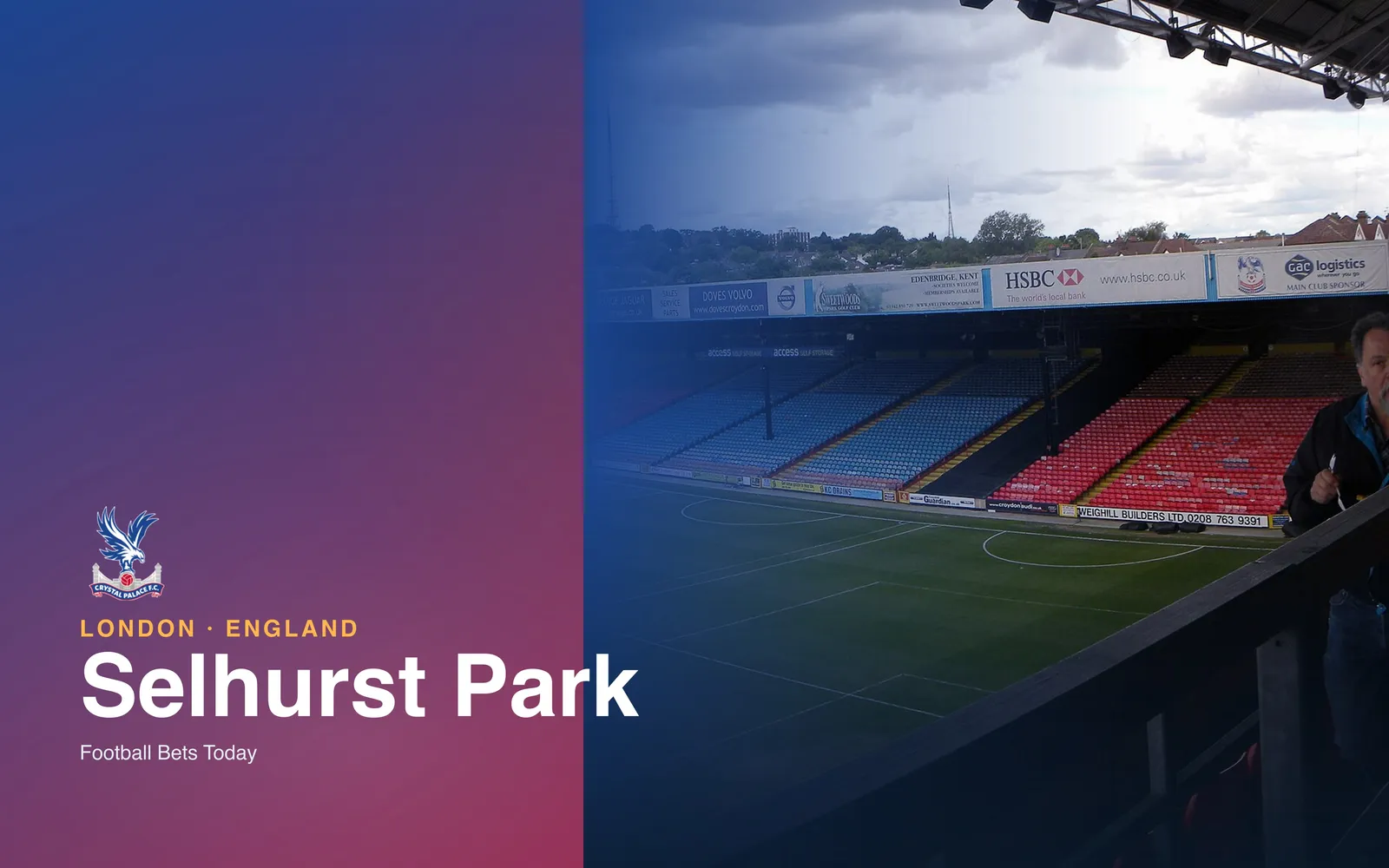
The ground
Facts
| Capacity | 25,194 |
|---|---|
| Opened | 1924 · renovated 1983, 1995, 2013 and 2014; Main Stand rebuild began June 2026, due early 2029 |
| Official name | Selhurst Park |
| Surface | hybrid |
| Owner | Crystal Palace |
| Record attendance | 51,482 · Crystal Palace 2-0 Burnley, Second Division (1979) |
| Getting there | Selhurst, Thornton Heath and Norwood Junction railway stations are all within walking distance; Norwood Junction also has London Overground. |
History
Matches it is known for
- England v Wales 1926
- Two football matches at the 1948 Olympics
- Real Madrid floodlight match early 1960s
- Charlton Athletic ground-share 1985-1991
- Wimbledon ground-share 1991-2003
- Chris Billam-Smith WBO cruiserweight title defence 2024
In depth
About Selhurst Park
Key takeaways
- Selhurst Park is Crystal Palace’s home ground in Selhurst, in the London Borough of Croydon, SE25.
- The stadium’s listed capacity is 25,194, although construction can affect the seats available for individual matches.
- Norwood Junction, Selhurst and Thornton Heath railway stations are all within walking distance.
- The planned Main Stand redevelopment would take overall capacity to about 34,000.
- Nigeria stays one hour ahead of Ghana throughout the year, while London changes its clocks.
Selhurst Park is a football stadium in Selhurst, in the London Borough of Croydon, SE25, and Crystal Palace’s home since 1924. Its listed capacity is 25,194 seats, giving football and soccer followers a compact London ground with a substantial history.
For a first visit, the immediate answers are straightforward: Palace play here, and Norwood Junction, Selhurst and Thornton Heath stations provide walking approaches. The detail matters when choosing a stand or planning a journey from Africa. The flight into London is only the first leg, and the short walk from one of those three stations decides how your matchday begins.
What Is the Capacity of Selhurst Park?
Selhurst Park’s listed capacity is 25,194. Holmesdale Road is listed at 8,329 seats and Arthur Wait at 9,574. These figures describe the ground’s arrangement, rather than establish how many tickets are available for a particular fixture.
Arthur Wait includes an away allocation of about 3,000 within its listed total, rather than additional seats. Construction, segregation and the configuration used for a match can affect availability. For a visit while the redevelopment is under way, read the seating plan attached to your chosen fixture before selecting a block. The familiar stadium capacity should never be treated as a promise that every seat will be offered.
Who Plays at Selhurst Park Stadium?
Crystal Palace have played at Selhurst Park since 1924, making the Eagles the ground’s enduring football identity. Other London clubs have also called it home: Charlton Athletic shared between 1985 and 1991, followed by Wimbledon between 1991 and 2003. That history explains why an older Selhurst fixture may feature Charlton or Wimbledon as the home side.
For Nigerian readers, Victor Moses provides a direct Super Eagles connection. Ghana’s Jordan Ayew and Ivory Coast’s Wilfried Zaha are other names that tie Palace to African football. These are historical connections, not a statement about the squad for this season. Use the team and lineup modules to establish who is involved in a selected match.
How Do You Get to Selhurst Park?
Norwood Junction, Selhurst and Thornton Heath are the railway stations to compare when travelling to Selhurst Park. Choose the approach that suits your accommodation and the entrance printed on your ticket. From each station, follow the signs and your ticket’s entrance instructions. Keep a street map open, because the correct turnstile may require walking around another side.
Check station exits and the walking route before setting off, particularly if engineering works alter your train journey. For readers arriving from abroad, a London airport is the beginning of the journey rather than the stadium’s neighbourhood. Reach your accommodation, check the rail service and leave room for the final walk and entrance queues.
Which Match Best Explains Selhurst Park’s History?
Palace’s title-clinching match against Burnley in 1979 is the defining historical fixture here, drawing the record crowd of 51,482 as Palace secured the Second Division title. That attendance belongs to a different stadium configuration and era. It should not be compared directly with the seated capacity listed today. The result gives the ground something more useful than a large number: a match through which to understand its place in supporters’ memories.
Selhurst Park opened on 30 August 1924, with the Lord Mayor of London performing the opening. Archibald Leitch designed the ground, and only the Main Stand existed at the start, still unfinished because of industrial action. Later changes reshaped the setting: Arthur Wait opened in 1969, while the Holmesdale Road terrace became a two tier stand in 1994 and 1995. The stadium’s name remained Selhurst Park through those changes.
What Does the Main Stand Redevelopment Change?
The Main Stand redevelopment plans a three tier structure holding about 13,500, taking the stadium’s overall capacity to about 34,000. Croydon Council approved the project in 2018 and approved revised plans in August 2024, with completion expected in early 2029. Timetables of this kind can move, so a visitor should check construction arrangements for the fixture being booked.
The proposed 13,500 seats replace the existing Main Stand provision; they are not simply added to the old ground’s total. Equally, the eventual capacity does not describe the seats available while the redevelopment is under way. A temporary seating plan may change entrances, views or the blocks on sale. When comparing football stadiums, keep two ideas in mind: the established ground and the completed redevelopment.
What Are the Pitch and Stands Like?
The pitch measures 101 by 68 metres, surrounded by Holmesdale Road, Arthur Wait, the Main Stand and Whitehorse Lane. Arthur Wait contains the usual away section. To find your stand, follow the signs and your ticket’s entrance instructions.
Choose your seat according to the experience you want and the ticket conditions for that fixture. A side view makes team shape easier to follow; a position behind the goal brings a different perspective on attacks. Away supporters should select the designated visiting section. Buy through the authorised ticket route, check any purchasing conditions and read the entrance instructions before travelling. Seat location matters more than finding a familiar stand name on a map.
What Else Has Selhurst Park Hosted?
Selhurst Park’s history extends beyond Palace fixtures, including England against Wales in 1926 and two football matches at the 1948 Olympics. Those events place the ground within international football history as well as London club life. Its identity has also travelled through television: Selhurst Park supplied the setting for the fictional Nelson Road in Ted Lasso, introducing its stands to viewers who may never have followed a Palace fixture.
On 15 June 2024, Chris Billam-Smith retained his WBO cruiserweight title against Richard Riakporhe at the stadium. That boxing night offers another way to understand the venue: the same stands can frame an entirely different sporting occasion. For football visitors, however, event photographs are not a seating guide. Check the configuration for your own booking, because a boxing layout and a Palace match use the space differently.
How Do African Fans Plan Around London Kick Off Times?
Kick off times depend on whether London is observing GMT or British Summer Time. Ghana stays on GMT all year, Nigeria follows WAT, South Africa follows SAST, and Kenya and Uganda follow EAT. Nigeria is therefore always one hour ahead of Ghana. For an illustrative 15:00 London start, the conversion changes when Britain changes its clocks, even though the five African countries keep their own clocks unchanged.
Nigeria and Ghana are the two of the five countries where Palace is followed most closely, largely through Victor Moses for Nigeria and Jordan Ayew for Ghana. Wilfried Zaha adds an Ivory Coast link that resonates across West Africa, and his name reaches fans in Kenya, Uganda and South Africa too. A 15:00 London start in winter becomes an evening watch: 16:00 in Lagos and Accra terms of the day, 17:00 in Johannesburg and 18:00 in Nairobi and Kampala. Many fans catch the match after work or school, at home, in a viewing centre or with friends, then spend the rest of the evening on the replays and the talk. Use the fixture module’s date and local time together, then check the viewing information for your country. If travelling, reconfirm the fixture before arranging the final rail journey, because television scheduling can move a match from its original slot. Save your ticket and entrance instructions before leaving your accommodation, and check the return train service before joining the crowd.
| London Clock | Ghana, GMT | Nigeria, WAT | South Africa, SAST | Kenya and Uganda, EAT |
|---|---|---|---|---|
| 15:00 GMT, UK winter | 15:00 | 16:00 | 17:00 | 18:00 |
| 15:00 BST, UK summer | 14:00 | 15:00 | 16:00 | 17:00 |
FAQ
What is the capacity of Selhurst Park?
Selhurst Park’s listed capacity is 25,194. The Main Stand redevelopment proposes an eventual capacity of about 34,000, while availability during construction depends on the seating arrangement for each fixture.
Who plays at Selhurst Park?
Crystal Palace have played at Selhurst Park since 1924. Charlton Athletic shared the ground from 1985 to 1991, and Wimbledon from 1991 to 2003.
How do I get to Selhurst Park?
Travel by rail to Norwood Junction, Selhurst or Thornton Heath, then walk to the stadium. Compare the rail service and your ticket’s entrance before choosing a station, and check a street map for the final approach.
When did Selhurst Park open?
Selhurst Park opened on 30 August 1924, with the Lord Mayor of London performing the opening. Archibald Leitch designed the ground.
What time is a 15:00 London kick off in Nigeria, Ghana, Kenya, Uganda and South Africa?
In UK winter, 15:00 in London is 15:00 in Ghana, 16:00 in Nigeria, 17:00 in South Africa and 18:00 in Kenya and Uganda. In UK summer, each time is one hour earlier.
Written by Tunde Akinwande, 2026-11-11.